AI Career Roadmap: Artificial Intelligence and Machine Learning Jobs
Introduction to AI and Machine Learning
Today, many companies describe their products and services as “Powered by AI,” but not all of them actually use Artificial Intelligence. Sometimes, companies use the term mainly to attract customers. So, before exploring AI careers, it is important to understand what Artificial Intelligence, Machine Learning, and Deep Learning mean.
Artificial Intelligence (AI) is a technology that helps computers and machines perform tasks that usually require human intelligence, such as learning, solving problems, understanding information, and making decisions. For example, ChatGPT and voice assistants use AI to help people with different tasks.
ML is a part of AI that helps computers learn data and make decisions. Instead of giving instructions for every task, we provide data to the computer so it can identify patterns and make predictions. For example, YouTube recommends videos based on what you watch, while email services identify unwanted spam messages.
Deep Learning (DL) is a more advanced part of Machine Learning. It uses special computer systems called artificial neural networks, which are inspired by the human brain. These networks help computers understand complex information, such as images, sounds, and language. For example, deep learning powers face recognition, voice recognition, and image recognition.
In simple words, AI helps machines perform intelligent tasks, Machine Learning helps them learn from data, and Deep Learning helps them understand more complex patterns using neural networks.
Why Choose a Career in AI and Machine Learning?
Artificial Intelligence and Machine Learning are creating new career opportunities in the technology industry. Many companies use these technologies to automate tasks, analyze data, improve services, and make better decisions. AI and ML are widely used in healthcare, finance, education, manufacturing, agriculture, and transportation.
Students interested in this field can explore artificial intelligence and machine learning jobs such as AI Engineer, Machine Learning Engineer, Data Scientist, and AI Researcher. They can also learn about Deep Learning, Natural Language Processing, Computer Vision, and Generative AI. To start a career in AI and ML, beginners should learn programming languages like Python, basic mathematics, statistics, and data analysis. Working on practical projects, completing online courses, earning certifications, and joining internships can help students develop useful skills and gain experience.
Applications Across Industries
Artificial Intelligence is used in many industries to make work easier, faster, and more efficient. In healthcare, it helps doctors examine medical reports, identify possible diseases, and support medical research. Banks use AI to detect suspicious transactions and prevent fraud, while educational platforms use it to provide personalized learning and study assistance. In transportation, AI helps with traffic management, route planning, and self-driving technology. Manufacturing companies use it to monitor machines, detect product defects, and improve production quality. In agriculture, AI helps farmers monitor crop health, identify plant diseases, and estimate crop production.
AI is also used in everyday services such as customer support, online shopping, and entertainment. Chatbots answer customer questions, shopping platforms recommend products, and streaming services suggest movies and videos based on user interests. Natural Language Processing (NLP) helps computers understand and generate human language through applications such as translation tools, voice assistants, and text summarization. Overall, AI is helping different industries improve their services, save time, and solve real-world problems.
Step-by-Step AI and Machine Learning Career Roadmap
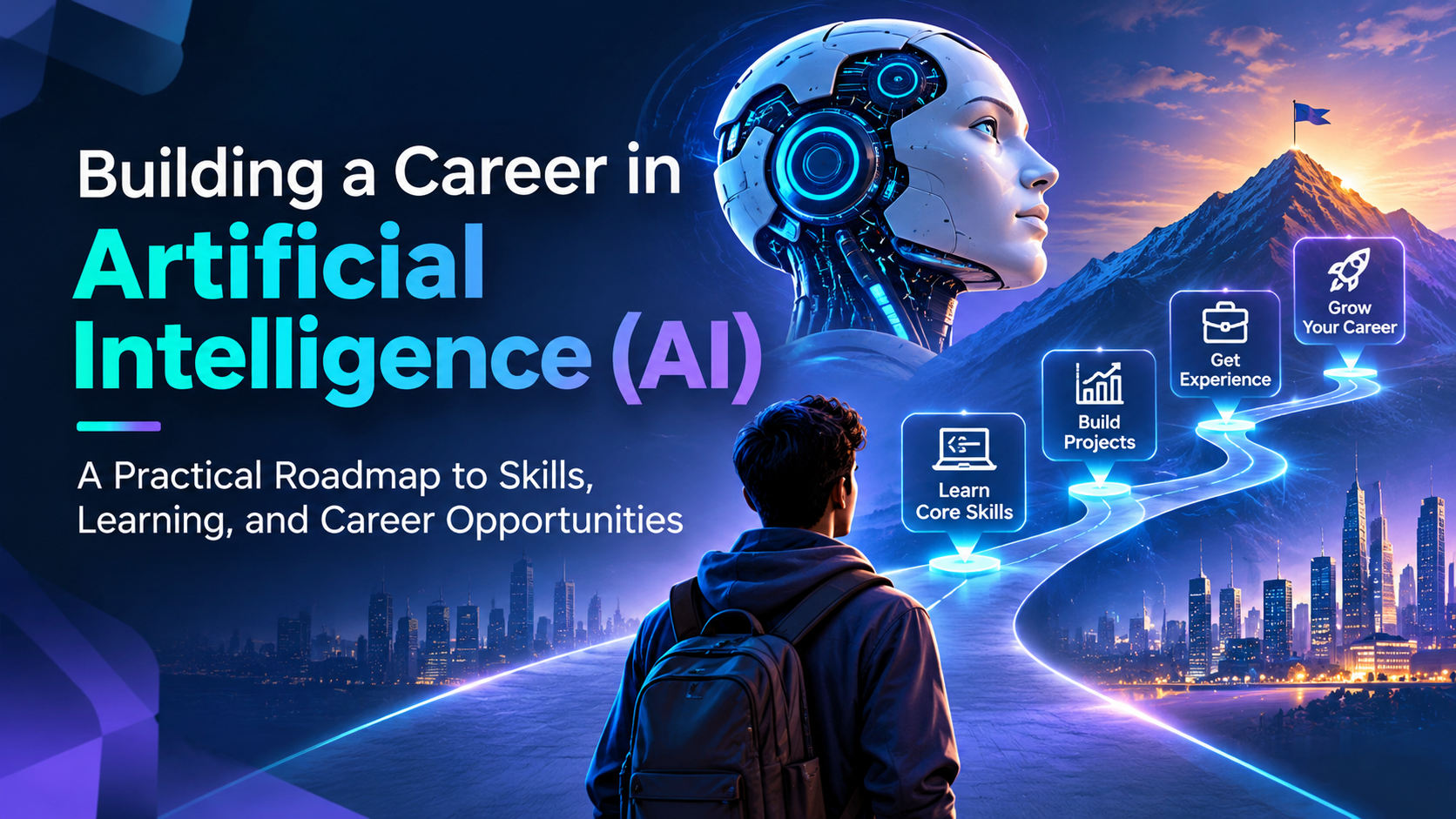
Building a career in Machine Learning requires learning technical skills step by step. Beginners should first understand the basics of mathematics, statistics, probability, and data analysis because these subjects help explain how machines learn from data. The next step is to learn Python, one of the most popular programming languages used in Machine Learning. Students should also understand how to collect, organize, clean, and prepare data using libraries such as Pandas and NumPy. Once they have a basic understanding of data, they can move on to Machine Learning algorithms and learn about supervised learning, unsupervised learning, model training, testing, and evaluation. These concepts help computers identify patterns and make predictions using available data.
After learning the fundamentals, students can explore advanced topics such as Deep Learning and neural networks. They can also practise using tools and libraries like TensorFlow and PyTorch to build and train Machine Learning models. Learning Git and GitHub is useful for managing code, tracking project changes, and sharing work with others. Students should also understand how to test and deploy their models so that they can be used in real-world applications. Once they gain confidence, they can explore specialized areas such as Natural Language Processing (NLP), Computer Vision, and Generative AI. Working on practical projects, completing online courses, participating in internships, and building a portfolio can help students improve their technical knowledge and gain practical experience. By following this AI career roadmap with regular practice, beginners can gradually prepare themselves for opportunities in Machine Learning and Artificial Intelligence.
Career Opportunities: Future Jobs in AI
Artificial Intelligence offers many career opportunities for students interested in technology. To start, students should learn basic mathematics, statistics, programming, and Python. They can also explore Machine Learning, Deep Learning, and Data Science. Skills like problem-solving, communication, and teamwork are equally important. Students can improve their knowledge through online courses, certifications, practical projects, and internships. Building a portfolio and keeping up with new technologies can also help them prepare for future jobs in AI.
How to Prepare for an AI Career
AI is creating new career opportunities in fields like healthcare, finance, education, and technology. Students can prepare for these careers by learning Python, mathematics, Machine Learning, data analysis, and cloud computing. Practical projects, online courses, certifications, and internships can help them gain useful experience. As AI technology continues to grow, regular practice and continuous learning are important for building a successful career. EkasCloud supports learners through practical training, mentorship, and career guidance.
Conclusion
Artificial Intelligence is creating many new career opportunities in different industries. Students who learn programming, Machine Learning, data analysis, and cloud computing can prepare themselves for future jobs. Practical projects, certifications, and internships can also help them develop useful skills and gain experience. Since technology keeps changing, continuous learning and regular practice are important for building a successful career in AI.
Start Your Career with Codomax Digital
Are you interested in building a career in the technology industry? Codomax Digital offers internship opportunities where students can improve their skills, work on practical tasks, and gain valuable experience. Start learning, explore new opportunities, and take your first step towards a brighter professional future.
Apply Now: Codomax Digital Internship