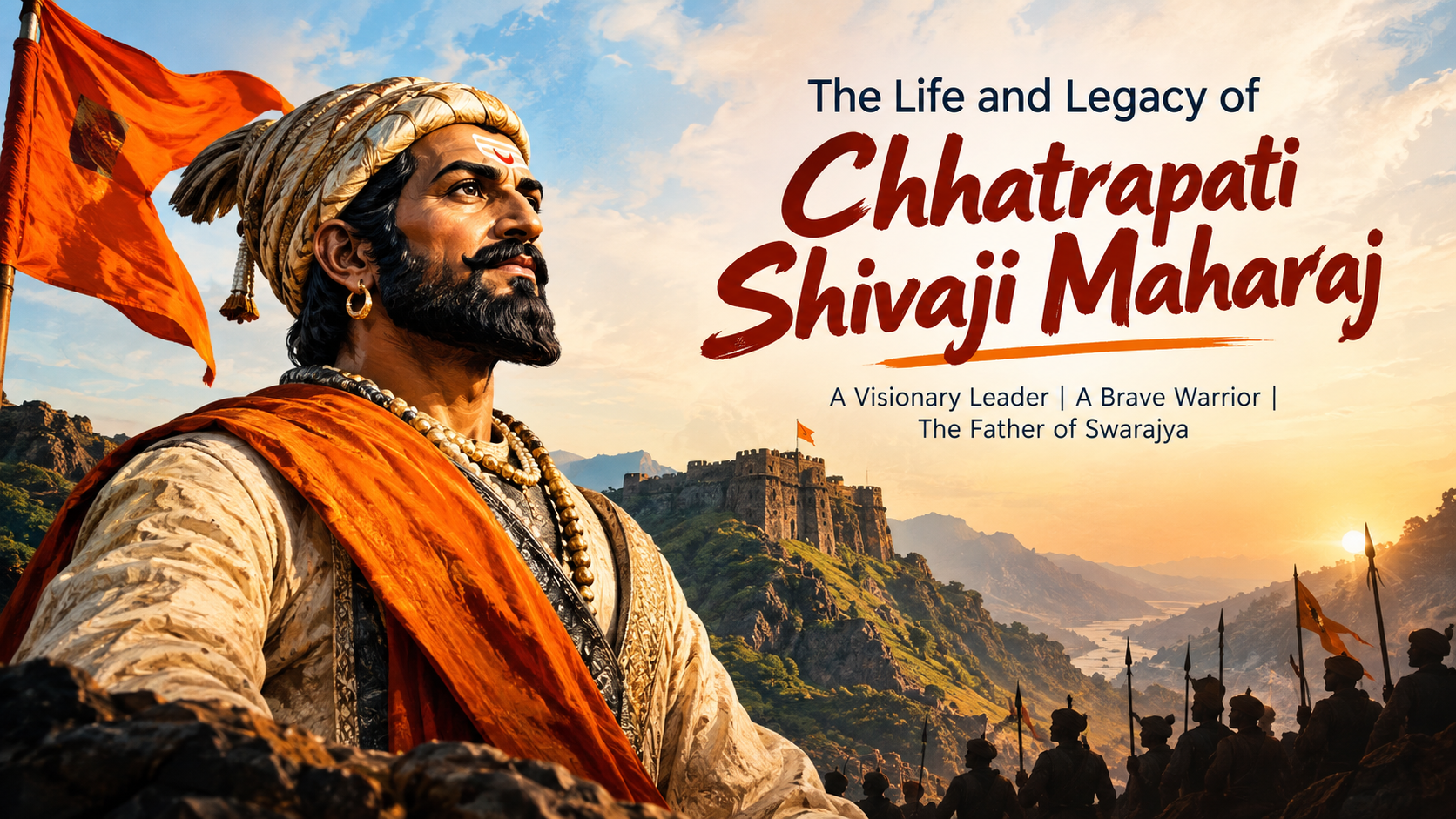
Introduction to Chhatrapati Shivaji Maharaj
Chhatrapati Shivaji Maharaj was one of the most important rulers of the 17th century. He founded the Maratha state and worked to develop an independent kingdom in western India. He is remembered for his bravery, military strategy, strong forts, naval power, effective administration, and the idea of Swarajya.This shivaji maharaj introduction in english provides an overview of his life, rise to power, military strategy, administration, important warriors, and legacy.
History of Chhatrapati Shivaji Maharaj
Chhatrapati Shivaji Maharaj was born on 19 February 1630 at Shivneri Fort in Maharashtra. His parents were Shahaji Bhosle and Jijabai. He started his own kingdom by challenging the Bijapur Sultanate. Later, he also fought against the Mughal Empire.This shiva ji biography covers important events from his early life, rise to power, military campaigns, administration, and legacy.
Early Life of Chhatrapati Shivaji Maharaj
Shivaji Maharaj's early life was greatly influenced by his mother, Jijabai, and his guardian, Dadoji Kondadeo.Jijabai taught him strong values and gave him a deep connection with his culture and traditions. Dadoji Kondadeo taught him administration, military planning, and revenue systems.Understanding shivaji life history helps explain the experiences that shaped his leadership and his vision of Swarajya.
Rise to Power
Shivaji Maharaj started capturing forts at a young age. In 1646, at the age of 16, he captured Torna Fort. He later captured important forts around Pune. He made Rajgad his headquarters.
Wars and Military Strategy
Shivaji Maharaj was famous for his guerrilla warfare, known as Ganimi Kawa.His soldiers used:Fast attacksSurprise attacksKnowledge of mountains and local areasQuick movement and strong forts for defence.This shivaji maharaj military strategy helped him fight against both the Bijapur Sultanate and the Mughal Empire.
Battle of Pratapgarh
Shivaji Maharaj's army fought the Battle of Pratapgarh against Afzal Khan's forces from Bijapur. The Battle of Pratapgarh was fought in 1659. The Marathas won this battle, which became an important victory for Shivaji Maharaj.
Conflict with the Mughals
Shivaji Maharaj also fought against the Mughal Empire.In 1665, he signed the Treaty of Purandar. In 1666, Aurangzeb called Shivaji Maharaj and his son Sambhaji to Agra. Shivaji Maharaj was kept under house arrest but successfully escaped with his son.In 1670, the Marathas again recaptured Sinhagad Fort from the Mughals.
Administration of Chhatrapati Shivaji Maharaj
Ashta Pradhan Council
He formed the council of eight ministers known as the Ashta Pradhan.
Each minister had different responsibilities, such as:AdministrationFinanceMilitaryForeign affairsJusticeReligious matters
He also promoted Marathi and Sanskrit for official work.
Forts and Naval Power
Forts were very important to Shivaji Maharaj's military strategy. He captured and built many forts, including Torna, Rajgad, Purandar, and Sinhagad.He also understood the importance of naval power. He built a navy to protect the Konkan coast.Chhatrapati Shivaji is called the “Father of the Indian Navy”. Chhatrapati Shivaji established a powerful naval force to secure trade routes, protect ports, and challenge European dominance. His visionary strategies transformed India's maritime history and coastal defence.
The Great Mavlas of Chhatrapati Shivaji Maharaj
Soldiers of Shivaji Maharaj are known as Mavlas. The brave Mavlas of Chhatrapati Shivaji Maharaj fought bravely for Swarajya.
Bajiprabhu Deshpande
Bajiprabhu Deshpande belonged to the Chandrasainya Kayastha Prabhu community, which was traditionally connected with administrative work. From a young age, he was brave and interested in warfare. He wanted to serve his land and stand against the powerful forces of the Deccan.When Shivaji Maharaj started the movement for Hindavi Swarajya, Bajiprabhu joined him. He became an important commander in the Kolhapur and southern Maharashtra region. Bajiprabhu also led experienced warriors from the Bandal regiment. He played an important role during the conflict with Afzal Khan.
Tanaji Malusar
Tanaji is most famous for his role in the Battle of Sinhagad in 1670. Shivaji Maharaj asked him to recapture Kondana Fort, near Pune, which was under Mughal control.According to popular accounts, Tanaji received the message about the mission while his son was getting married. He immediately left the wedding preparations and accepted the responsibility. He is traditionally associated with the words “Aadhi lagin Kondanyacha”, meaning that the fort should come first.Tanaji and his soldiers secretly climbed the fort walls at night. Popular stories say that they used a ghorpad (monitor lizard) with a rope to help them climb the steep fort walls.After reaching the fort, Tanaji and his soldiers fought the defenders. A fierce fight took place between Tanaji and Udaybhan Rathod, the fort's commander. During the battle, Tanaji lost his shield but continued fighting by using a cloth to protect his hand. Tanaji was eventually killed in the battle.
Murarbaji Deshpande
Murarbaji Deshpande was a well-known warrior who was connected with Chhatrapati Shivaji Maharaj and the defence of Purandar Fort. Murarbaji was a member of the Deshpande family, and the Deshpandes occupied important administrative posts in the Deccan at that time.Yet there is only limited information concerning the exact date of Murarbaji's birth, his childhood, and his early education. Murarbaji is primarily remembered for his courage, determination, and leadership; he gained a reputation as a skilled warrior and military commander.
He was trained in the traditional skills needed by warriors of that time, including:
1.Sword fighting
2.Horse riding
3.Use of weapons
4.Physical training and fort warfare
Prataprao Gujar
The early history of Prataprao Gujar is clouded in mystery, as very few historical records regarding this personality have been discovered.It is known that he was born as Kudtoji Gujar in 1615 in Bhosare, located some 40 km to the east of Satara in Maharashtra.Kudtoji's career progress can be traced back to the early 1660s when he was appointed Sarnobat (chief military commander) of the strategically located fortress of Rajgad, the first capital of the Maratha kingdom.This position was reserved for the most trusted and skilled commanders of the Marathas. He became famous under the name of Prataprao Gujar and played one of the leading roles in the military activities of Shivaji Maharaj.
Yesaji Kank
Yesaji Kank was a personal officer in the service of Shahaji Raje Bhosale, the father of Shivaji Maharaj.The Kank family traditionally belonged to the Kayastha Prabhu community and had experience in administration and recordkeeping in the service of various Deccan rulers.Yesaji Kank was known for his discipline, administrative skills, literacy, and loyalty.When Shahaji Raje moved to Bijapur and became a powerful jagirdar, Yesaji Kank is thought to have followed him and served under him as one of his close officers in his new position.His close and personal connection with Shahaji Raje most likely contributed to the fact that Yesaji Kank became associated with the early years of Shivaji's reign.
Jiva Mahala
Jiva Mahale was a great warrior and belonged to the history of the Maratha kingdom. He was known for his loyalty and bravery towards Chhatrapati Shivaji Maharaj.Jiva Mahale was one of the bodyguards of Shivaji Maharaj. He is particularly remembered for protecting Shivaji Maharaj during the famous meeting with Afzal Khan, the general of Bijapur.It happened on 10 November 1659, when Shivaji Maharaj and Afzal Khan met each other at the foothills of the Pratapgad Fort.There was a fight between Shivaji Maharaj and Afzal Khan, and Jiva Mahale immediately jumped in to protect Shivaji Maharaj from Afzal Khan.Due to his valour and devotion, a famous Marathi couplet “Hota Jiva Mhanun Vachla Shiva” emerged, which says that “Shiva was saved because Jiva was there.”Jiva Mahale is remembered as one of the brave soldiers of Shivaji Maharaj.
Bahirji Naik
Bahirji Naik is one of the trusted people of Chhatrapati Shivaji Maharaj. He was the chief of Shivaji Maharaj's intelligence team.His main job was to collect information about the enemy. He collected information about enemy soldiers, forts, roads, and their movements. This information helped Shivaji Maharaj make better plans.
Death and Succession of Shivaji Maharaj
Chhatrapati Shivaji Maharaj passed away on 3 April 1680 at Raigad Fort after suffering from illness for several weeks, and his funeral took place at Raigad in the presence of his son Rajaram and Soyarabai.Following his death, Sambhaji, who was the elder son, and Soyarabai fought over who was to control the kingdom, and after a brief struggle Sambhaji became king.
The 27-Year War
A few years later, Prince Akbar, who was the son of the Mughal emperor Aurangzeb, revolted against his father and Sambhaji offered him asylum.In 1681, Aurangzeb went to the Deccan with a big Mughal army since he wished to beat the Marathas and bring an end to their power.It began a war which went on for approximately 27 years.At the start, the Marathas had to deal with a big and powerful Mughal army and as a result they moved their capital from Raigad to Jinjee (Gingee) in the south.For a while it seemed as though the Mughals could defeat the Marathas, but the Marathas gradually altered their strategy and put up a fight.
Maratha Resistance
Generals of the Maratha army, including Santaji Ghorpade and Dhanaji Jadhav, carried out rapid attacks on the Mughal army.They employed rapid movements and surprise attacks, just as Shivaji Maharaj had developed.As time went on, the Marathas grew in strength and the Mughal army suffered a number of defeats.Aurangzeb devoted many years and a great deal of money and soldiers in an attempt to defeat the Marathas, but he was unable to completely destroy the Maratha kingdom.In 1705, Aurangzeb left the Deccan due to his failing health and he died in 1707.The prolonged war had seriously undermined the Mughal Empire.
Legacy of Shivaji Maharaj
Even after the death of Shivaji Maharaj, the Marathas kept on fighting in order to defend Swarajya and carry on the work which he had begun.The prolonged struggle against the Mughals demonstrated the strength of the Maratha movement and Shivaji Maharaj's ideas regarding self-rule continued to influence the Maratha leaders after his death.The historian Jadunath Sarkar states that hundreds of thousands of soldiers from both sides died during the long conflict.Shivaji Maharaj left a powerful Maratha kingdom and an important legacy in the areas of leadership, courage, and Swarajya; his influence over the Marathas lasted for many years after his death.